Calibration output files
When you export, realtime-calib writes one file per selected target. Every target carries the same calibration — the same intrinsics and 6-DoF poses — in a different shape and coordinate convention. Everything lands in the session folder, which is the source of truth for a run.
Files written
| File | Format | For |
|---|---|---|
camera_array.toml | Caliscope-native TOML | Caliscope & OpenCV-style pipelines |
camera_array_threejs.json | Engine JSON | three.js / OpenGL |
camera_array_blender.json | Engine JSON | Blender / ROS |
camera_array_unity.json | Engine JSON | Unity |
camera_array_unreal.json | Engine JSON | Unreal |
You pick which targets to export (any subset) and the length unit (mm or m). The session folder also holds the recordings, board config and computed results.
Coordinate conventions
Each engine JSON is written in its target's world convention — a combination of up axis (Y or Z) and handedness (left or right):
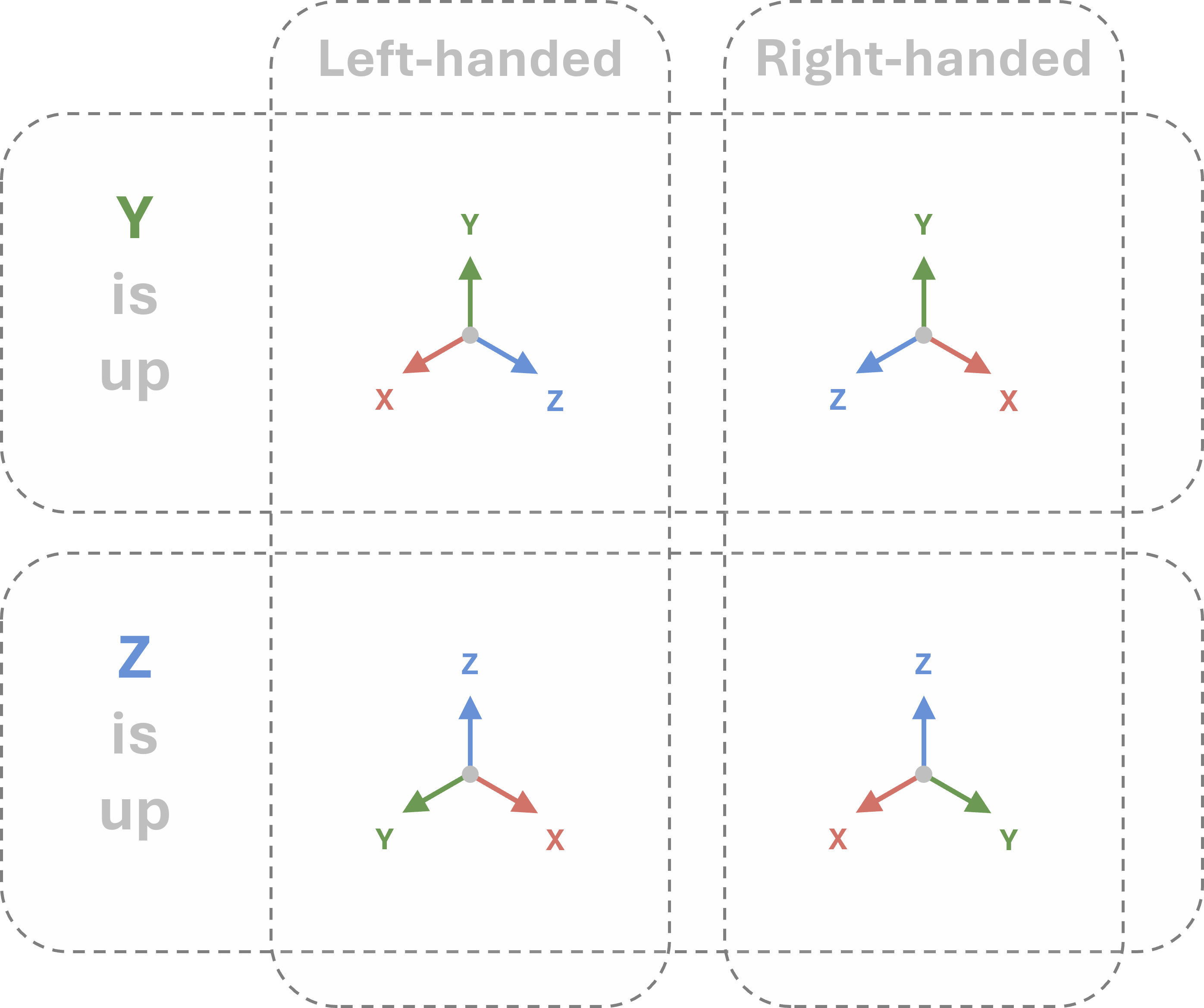
Coordinate conventions. The four world conventions realtime-calib exports to — up axis (Y or Z) combined with handedness (left- or right-handed).
Each convention maps to a target engine:
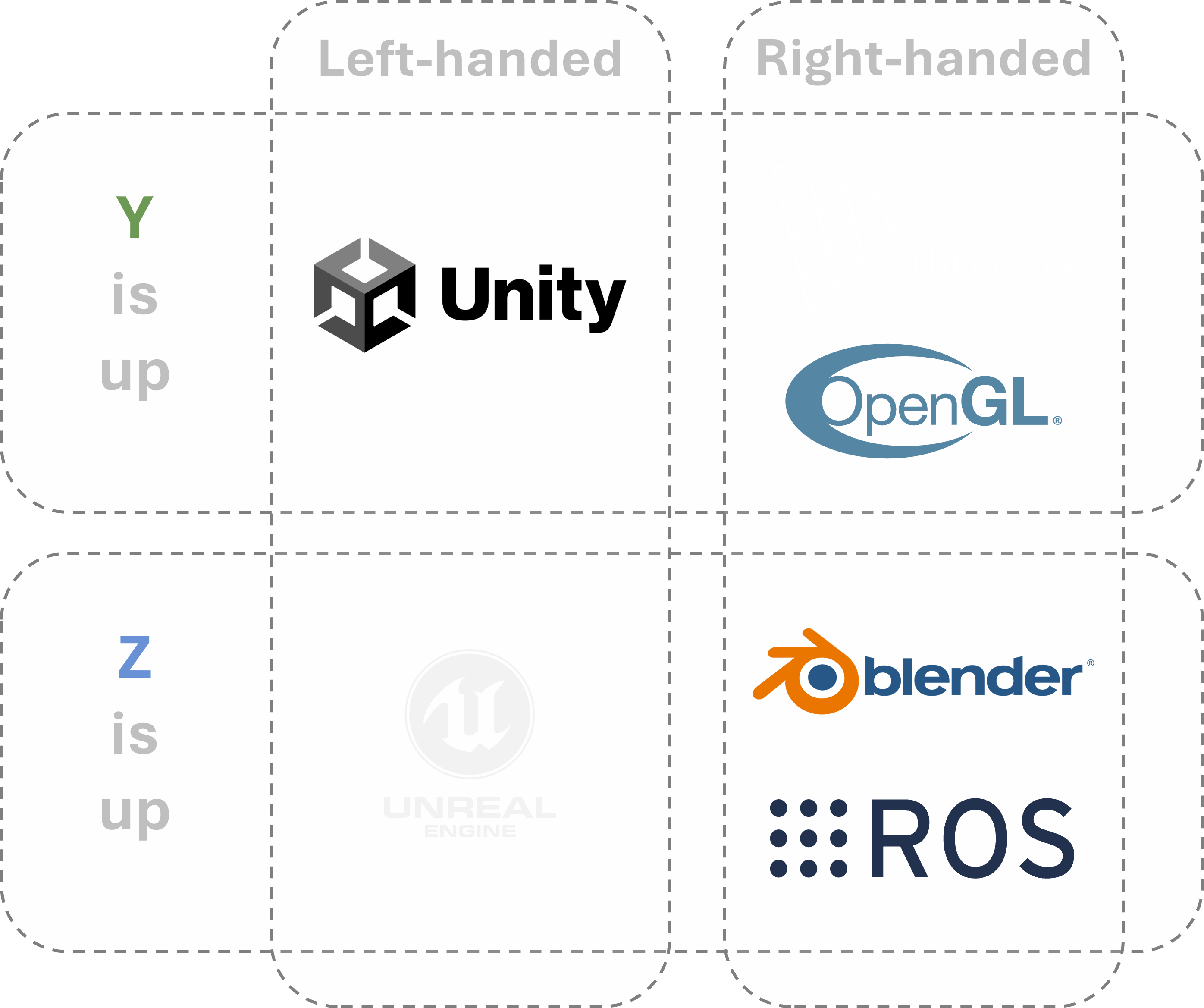
Target software per convention. Unity (Y-up, left-handed), three.js / OpenGL (Y-up, right-handed), Unreal (Z-up, left-handed), Blender / ROS (Z-up, right-handed).
The Caliscope TOML keeps OpenCV's native axes (right-handed, Y-down, Z-forward).
Caliscope TOML (camera_array.toml)
Compatible with Caliscope: native field semantics are preserved, project-specific
fields are strictly additive. One [cam_N] table per camera.
| Field | Meaning |
|---|---|
port | Camera index / identifier |
size | Image size [width, height] at the calibration resolution |
matrix | 3×3 intrinsic matrix |
distortions | Distortion coefficients — 5, OpenCV classic model [k1, k2, p1, p2, k3] |
rotation | Extrinsic rotation, Rodrigues vector (world→camera) |
translation | Extrinsic translation, in the selected export units (mm or m — Caliscope's own files are metre-scaled) |
error | Reprojection error (RMS) |
grid_count | Number of board views (keyframes) used for the intrinsic solve |
Additive, non-Caliscope extensions: name (operator label) and device_path
(stable V4L identifier).
[cam_0]
port = 0
name = "cam_0"
size = [ 1920, 1080 ]
matrix = [ [ 1000.0, 0.0, 960.0 ], [ 0.0, 1000.0, 540.0 ], [ 0.0, 0.0, 1.0 ] ]
distortions = [ 0.0, 0.0, 0.0, 0.0, 0.0 ]
rotation = [ 0.0, 0.0, 0.0 ]
translation = [ 0.0, 0.0, 0.0 ]
error = 0.0
grid_count = 0
Engine JSON (camera_array_<target>.json)
A self-describing document: a top-level convention block (up axis, handedness,
axis mapping, camera_forward / camera_up), the world_units, the anchor
camera name, and a cameras array.
Each camera carries a scene form — what a scene graph applies to place the camera object:
| Field | Meaning |
|---|---|
position | Camera position in world units (mm or m) |
quaternion | Camera orientation [x, y, z, w] (camera→world) |
matrix | 4×4 camera→world transform |
intrinsics | { resolution, matrix, distortions, fov_deg } |
error | Reprojection error |
name, device_path | As in the TOML |
Right-handed targets (three.js, Blender) additionally carry a view form —
the OpenCV-style extrinsic for projection (x_cam = R · x_world + t):
| Field | Meaning |
|---|---|
view.R | 3×3 rotation, world→camera |
view.t | translation vector, world→camera (world units) |
Left-handed targets (Unity, Unreal) omit the view form: their world basis
includes a mirror (det = −1), which would make the view rotation improper (a
reflection, not a rotation) — project through the engine's own camera API instead.